Why Green Telemetry and Wrong Outputs Coexist Without Contradiction
Agent observability must track decision quality, not just whether requests complete successfully.
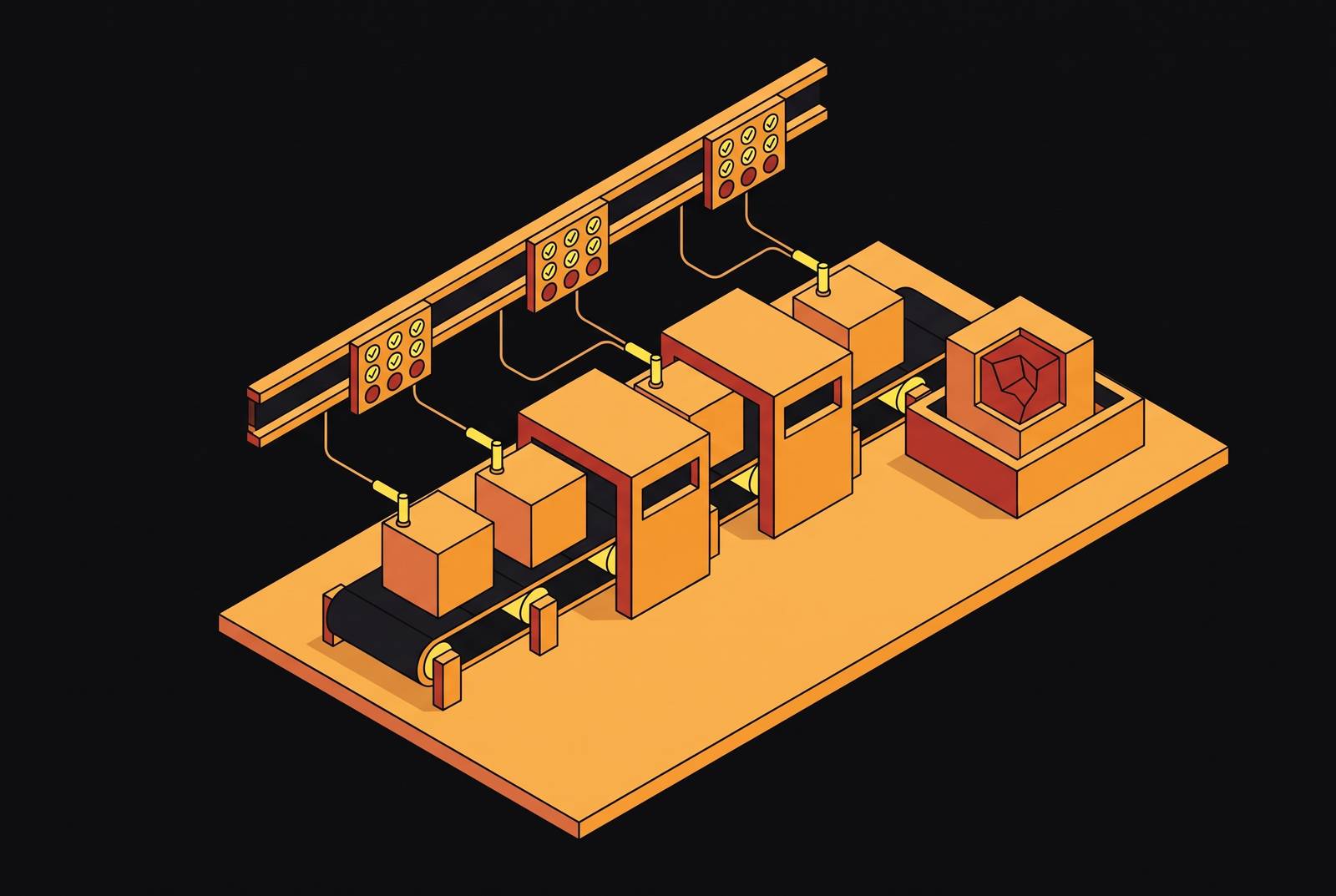
Traditional error monitoring fails for AI agents because it uses request delivery to assess the correctness of the agent’s decisions. Green telemetry and wrong outputs therefore coexist without contradiction. Agent observability needs to measure the execution trajectory against intended behavior, rather than treating successful delivery or a plausible final answer as evidence of correctness.
Why infrastructure monitoring is built for a different failure mode than agents produce
Infrastructure monitoring checks whether the transport layer completed a request without crashing. HTTP status codes, latency percentiles, exception counts, and uptime dashboards describe delivery. Those signals have a clear purpose. They distinguish an available service from an unavailable one, or a completed request from an execution error. A response can satisfy all of those conditions while containing information the user should not trust.
Traditional software gives this design a reasonable foundation because a microservice runs deterministic computation rather than choosing its execution path through LLM decision-making. Delivery health can then give a useful sign of output health, though software can run successfully and still be wrong. Infrastructure monitoring was not designed to evaluate claims, judge context relevance, or establish whether an answer fulfills a user’s request. That boundary is part of its design. Its implied operational bet is that, once the computation is established, a successful response is a correct response.
Why does an LLM agent look fine in logs but still give bad outputs?
An agent’s execution trajectory is decided dynamically for every request because it relies on an LLM to make decisions. That trajectory includes the steps the agent took, the tools it called, and the agents it invoked. It is not fixed at compile time. The same input query can lead to different tool selections, different context passed downstream, and different final content, even when every request returns HTTP 200.
Non-determinism means that successful execution no longer identifies a stable sequence of decisions whose correctness can be assumed from delivery health. The agent may carry out each step it chose successfully even when those steps do not help with the task. This separates execution success from task success. A tool call can work exactly as requested even when choosing that tool was the wrong decision.
IBM Research’s Detecting Silent Failures in Multi-Agentic AI Trajectories describes the resulting failures as deviations from intended behavior that generate no clear error signals. In a multi-agent pipeline, Agent A can pass incomplete or irrelevant context to Agent B, which then produces a confident but wrong response. No error is thrown, no exception is logged, and the monitoring dashboard stays green. The handoff succeeded as a transfer but failed as a transfer of the context the task required. In this arrangement, the delivery layer completed its job while the reasoning layer failed, and only the former was wired to an alert.
What silent failures actually look like in production
IBM Research names five forms of silent failure. Drift means selecting irrelevant tools or subsequent agents, while cycles mean looping redundantly without triggering errors. Missing details in final output leave required information out of an otherwise completed response. Tool failures handled silently are API errors the agent neither detects nor surfaces, and context propagation failures pass incorrect context to dependent agents or tools. These are task failures that can occur while the service remains operational. Their defining feature is that the agent’s behavior departs from its purpose without producing the error signal operators would ordinarily expect.
Bajaj et al.’s Evaluation Blindness: How Silent Measurement Failures Corrupt AI Systems from Training to Deployment describes an airline’s chatbot telling a passenger that a non-existent retroactive bereavement fare application procedure existed. The output passed every implicit quality check in the integration pipeline, and the airline was found liable. The case makes the operational and legal stakes concrete without requiring a transport failure.
Liu et al.’s Silent Failure in LLM Agent Systems: The Entropy Principle and the Inevitable Disorder of Autonomous Agents adds a longer-run dimension. The study reports silent failures under fully controlled conditions, including static prompts, identical models, fixed databases, and no external inputs. It formalizes the monotonic accumulation of disorder over interaction rounds as the Entropy Principle. A launch check is therefore only a snapshot. An agent that passes its checks at release may degrade without a configuration change, model update, or code push providing an obvious explanation, making silent failure a continuing production concern.
Why the failure is invisible — the measurement function produces no distinguishing signal
Bajaj et al. call the inability to distinguish failing from non-failing states evaluation blindness. A measurement function is blind to a failure class when it produces a value indistinguishable from a non-failing state while the system is failing, and no auxiliary signal flags the discrepancy. The distinction is precise. An alert cannot discriminate between healthy and failing behavior if its input represents both states in the same way. Adjusting the alert threshold does not supply information that the measurement never captured.
The same paper finds that more than half of verifiable public incidents are silent by this definition. It describes failures propagating through training loops, evaluation pipelines, and production monitoring stacks until downstream harm makes them visible. In one May 2026 case, 1,100 tickets were mis-routed over nine days before any alert fired. The delay was operationally consequential.
The paper also uses Mata v. Avianca to show how blindness can extend beyond automated monitoring. A legal brief containing citations to six non-existent cases passed the attorney’s review process because the measurement function for citation correctness produced no distinguishing signal between real and fabricated case names. No alert fired, and no quality metric degraded. Liu et al. describe the corresponding operational delay in agent systems, where systematic measurement detects failures after the fact rather than the monitoring stack detecting them in real time. By then, operators can be learning about errors that have already propagated across the agent network.
How existing failure taxonomies map the territory infrastructure cannot see
IBM Research formalizes anomaly detection in agentic trajectories as a task distinct from anomaly detection in microservices and networks. Its failure signatures reside in the structure of an execution. The distinction changes the object being examined. An irrelevant tool selection, redundant loop, or faulty context handoff is recognizable only in relation to the task and the surrounding sequence of decisions. Infrastructure measurements alone do not express those relationships.
Bajaj et al. organize deployment failures into six classes, namely Model Drift, Infrastructure, Integration, Evaluation, Safety & Compliance, and Operational. The paper identifies the Operational class as silent by structural definition. This broader taxonomy complements the trajectory study by locating failures across deployment concerns, while the study examines how deviations appear within agent execution.
The convergence is more useful than a longer catalogue. Independent research groups distinguish failures that conventional delivery signals do not adequately describe, giving the gap a structure that can be analyzed. That does not mean every infrastructure failure is invisible to infrastructure monitoring. Even when delivery measurements work as intended, they leave whole classes of agent failure unseen. Detection therefore needs criteria tied to decisions, handoffs, and task requirements.
Why measuring trajectories instead of outcomes is the right level of detection
Trajectory measurement can identify where an execution departed from intended behavior, while output measurement can judge only the result that reached it. This is the required change in measurement level. The relevant evidence is the sequence of decisions, tool calls, and context handoffs, interpreted against what the agent was supposed to accomplish.
The fidelity-trap research tested this distinction in controlled runs with planted silent failures. Fidelity-only scoring checked whether the final output matched the expected content and flagged none of them. A dispatch-level process detector recovered all of them by examining the trajectory. These controlled runs establish the scope of the result. Its broader significance is that an outcome score and a process detector can reach different conclusions because they inspect different evidence, independently of how sensitive their alert thresholds are.
Distributed tracing provides a span hierarchy that can expose this evidence, including the root span, agent span, LLM span, tool span, and retriever span. Those spans provide the raw material for examining decisions and handoffs. Visibility is necessary but not sufficient. A recorded tool call still needs to be assessed for relevance, and a recorded context transfer still needs to be assessed for whether it supplied what the receiving agent required. The detection function must connect the trace to intended behavior.
That connection also changes root-cause analysis. Instead of stopping at the finding that a final output was wrong, trajectory-level analysis can identify the specific step where Agent B received incomplete context from Agent A, leading to a confident wrong response downstream. The explanation locates the failed dependency rather than treating the final answer as the whole incident. Output evaluation still addresses whether the user received an acceptable result. Trajectory evaluation adds the process evidence needed to explain how that result arose and detect deviations that an acceptable-looking result can conceal.
Why the objection that “you just need better instrumentation” doesn’t resolve the problem
The strongest objection is that the necessary tools already exist. End-to-end traces, quality evaluations before and after release, and guardrails on unsafe tool calls can all help with failures that basic error monitoring misses. Teams that omit those signals have a practice gap. That objection is partly correct. Better instrumentation can show evidence that a status-code dashboard never collected, and the trajectory principle needs that evidence to work.
But even with richer signals, the evaluation function may lose its ability to tell correct behavior from failure. An agent’s behavior depends on its prompt, tools, retrieval corpus, and model version, including a provider’s silent update. An evaluation suite that was green last sprint may therefore be stale this sprint. Instrumentation can faithfully record execution while the criteria used to judge that execution no longer capture the relevant failures.
Liu et al. show why external changes are not the only concern. The study validates its entropy formalization across multiple architectures and task domains in over 100,000 agent interactions, including conditions with no code changes, model updates, or configuration modifications. Disorder can accumulate through interaction rounds themselves. Bajaj et al. identify a training-time counterpart in a GRPO implementation bug in a widely-used open-source RL training library, documented in TRL PR #6594. Training loss fell as expected and reward curves looked healthy even though gradients were corrupted throughout the affected runs.
The signals used to assess an agent can themselves become blind, so adding more measurements of the same property does not resolve the underlying problem. The architectural choice is to connect delivery telemetry, trajectory evidence, and evaluation criteria that express what the agent was supposed to do. Infrastructure monitoring still shows whether the service is healthy. Understanding its boundary lets teams build detection at the reasoning layer instead of repeatedly patching the delivery layer for failures it was never designed to distinguish.
Sources
- Silent Failure in LLM Agent Systems: The Entropy Principle and the Inevitable Disorder of Autonomous Agents
- Evaluation Blindness: How Silent Measurement Failures Corrupt AI Systems from Training to Deployment
- Fidelity Is Not Enough: Dispatch-Level Instrumentation for Agentic Datasheet Extraction
- Detecting Silent Failures in Multi-Agentic AI Trajectories