Hallucination Risk in Multi-Agent Handoff Chains
Fabricated facts become undetectable as they transform through agent handoffs.

Traditional error monitoring fails for AI agents because successful execution does not establish that an answer is correct. In multi-agent handoff chains, an upstream fabrication can become a derived result, a fluent explanation, and finally an accepted assumption without triggering an error. Hallucination risk therefore requires verification at handoff boundaries, before those transformations erase the evidence needed to detect it.
Why hallucinations in multi-agent chains are a different problem than hallucinations in single agents
A single-agent hallucination is a localized error, while a multi-agent hallucination can become a dependency for later work. In the first case, the wrong fact is available for direct evaluation. In the second, another agent receives it as context, often without its source or any indication of uncertainty. The receiving agent may reason correctly from a false premise.
Hamida Jafarova and Fatima Alakbarli describe hallucinations that originate at or are amplified by handoffs and propagate “embedded in fluent, confident context representations that downstream agents cannot scrutinize”. Each agent can check its own logic without establishing that its inputs are ground truth. Lin et al.’s HalluProp frames the resulting propagation as systemic risk, because interactions can amplify localized errors into cascading failures. Individual agent evaluation cannot characterize that process alone.
The three types of handoff hallucination and where each one enters the chain
Jafarova and Alakbarli distinguish three types by their origin relative to the handoff. Type I, or intrinsic hallucination, begins in the sending agent’s inference before any transfer occurs. A fabricated base figure passed to a calculating agent is a Type I error. The handoff transports an existing falsehood rather than creating one. Its detectability depends in part on whether the receiving agent still has the source needed to check it.
Type II, or extrinsic hallucination, enters through the transformation used to package, compress, or reformat an output. For example, reformatting an agent’s result can distort the content delivered to the next agent. The transfer itself creates the error in this case. Li et al.’s “Don't believe everything you read” reports that structure-aware analysis of real MCP servers found a material fraction misstate what the tool code actually does. That description-code inconsistency can mislead an agent at a boundary.
Type III, or context-collapse hallucination, occurs when compression removes epistemic markers, the signals that show what is known and what is uncertain. A hedged claim becomes a confident assertion when its qualification disappears. The sender need not have been overconfident. The handoff makes the claim seem more certain without adding evidence for it. This makes context collapse particularly difficult to identify through evaluations focused only on whether the sending agent behaved appropriately.
How hallucinations transform across pipeline stages rather than simply persisting
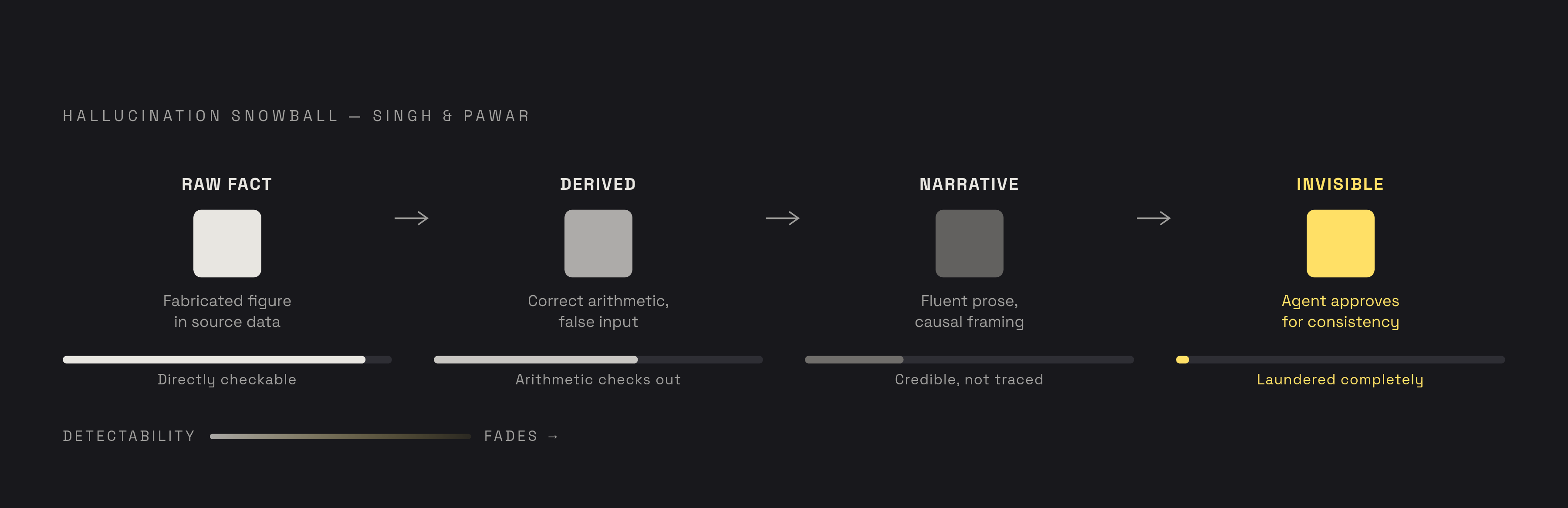
Prabhjot Singh and Bhushan Pawar formalize the “hallucination snowball effect” as a first-order Markov process with four states, namely Raw Fact, Derived, Narrative, and Invisible. The sequence describes changes in the form of an error. Each transformation makes the original fabrication harder to inspect. Their measurements show that hallucinations become much harder to detect at each stage, with a substantial share of injected hallucinations reaching the final output undetected. The chain progressively loses the information needed to challenge its own conclusions.
At Raw Fact, a fabricated base figure remains directly checkable against a source, if that source is available. At Derived, a downstream agent computes a result from the figure, and the original input may disappear from the handoff. Correct arithmetic cannot establish that the input was true. Verification now requires recovering the premise as well as examining the calculation.
At Narrative, a writing agent embeds the derived result in fluent prose and supplies causal framing such as “reflecting supply chain disruptions”. That explanation makes the result read as credible without giving it a sound factual basis. At Invisible, a reviewing agent approves the narrative for internal consistency without access to the original source. The hallucination is then “laundered completely”. What began as a checkable number has become an accepted explanation whose wording no longer exposes its origin.
This transformation also complicates the intuitive response of using a stronger reasoning model. “The Reasoning Trap: How Enhancing LLM Reasoning Amplifies Tool Hallucination” found that training a model to reason harder increased its rate of hallucinated tool calls. Capability alone did not suppress fabrication at that boundary. The finding rules out treating reasoning strength as a substitute for handoff controls. Engineering must control propagation throughout the chain.
Why does an LLM agent look fine in logs but still give bad outputs to users?
An agent can follow its assigned execution path to the end and still give a semantically wrong answer. This is the fail-plausible failure mode. Rather than reporting a failure, the system converts an error into a fluent, confident narrative and returns a success code. Conventional monitoring shows that the run finished, while the user gets a false conclusion. Internal consistency makes this mismatch especially difficult to spot after the original evidence has disappeared.
The invisible state explains why adding another review of the final prose may not expose the problem. A reviewer can assess coherence without having the means to test the underlying claim. Nothing needs to crash for the chain to fail. The operational signature can therefore include no error logs, no alerts, and no signal distinguishable from normal operation.
The production cases in the brief share this separation between operational success and task success. An agent succeeds at producing output but fails at producing correct output. Traditional monitors watch signals that do not establish semantic correctness, so their silence need not indicate a malfunction. Detecting the invisible state requires evidence about the task and its inputs, rather than confidence that the software completed its work.
How communication topology determines which agents amplify hallucinations and which contain them
HalluProp distinguishes intrinsic risk from interaction-induced risk. Intrinsic risk comes from conditions within an agent, including underspecified roles, conflicting objectives, and semantic misalignment between its role and the task query. Interaction-induced risk comes from communication structure and semantic influence. An agent with low intrinsic risk can still get misleading context from a sender that has strong influence over it. Its own reliability does not neutralize that exposure.
Position changes how far an error can travel. A low-intrinsic-risk agent in a high-propagation position can amplify an upstream fabrication more than a high-intrinsic-risk agent that is topologically isolated. This distinction separates the likelihood of originating an error from the reach of an error once introduced. The relevant architecture includes both the communication edges and the roles assigned to their endpoints. Evaluating agents without those relationships misses where risk concentrates.
HalluProp estimates this combined risk before inter-agent interaction, reporting an average AUROC of 84.6% in localizing faulty agents with sub-second diagnosis. For engineering teams, the implication is to distinguish agents likely to hallucinate from agents whose errors could corrupt the most downstream state. Those groups need not be the same. Controls should address both sources of risk, along with the quality of each model.
Why verification placed at boundaries beats verification placed at the end
Singh and Pawar’s model makes where to place verification a choice about how to spend resources. At the first boundary, between Raw Fact and Derived, the large majority of hallucinations remain catchable and their factual bases remain checkable. Later verification faces a different evidentiary problem. Their comparison found that boundary gates dramatically reduced hallucination survival, while end-of-pipeline checking produced only marginal improvement over no verification. The advantage came from intervening before transformation removed the information needed for a check.
Jafarova and Alakbarli propose a Handoff Verification Layer, or HVL, as a lightweight modular intermediary at each boundary. Its four components are a Factual Consistency Checker with recursive grounding retrieval, a Confidence Calibration Module, an authenticity scorer based on model scores, and a compressor that adapts to the subject area. The boundary becomes an explicit verification point. This design treats transfer as more than a formatting operation, because the receiving agent needs both usable content and signals about its evidentiary status.
HVL achieves close to zero hallucination rate at approximately 1.39× the token cost of an unmitigated baseline on HalloffBench scenarios, outperforming Reflexion and Multi-Agent Debate there. That benchmark result gives a concrete example of verified communication as an engineering approach, with no guarantee for every deployment. Handoff packages must preserve detectable epistemic status so recipients can distinguish confirmed information from uncertain claims. Verification at the first boundary has the greatest leverage, while subsequent boundaries remain potential sites of new distortion.
What production monitoring needs to do differently for multi-agent chains
Boundary verification does not remove the need to watch deployed chains for drift. Production monitoring must audit each trace against what the agent at that step was instructed to do. Self-reporting is not independent evidence of successful verification. “Agent A logs 'verified transaction'” records the agent’s claim. A monitor that accepts that claim without scrutiny can inherit the same blind spot as the next agent.
Monitoring needs at least step-level tracing to catch these failures. The same input can lead to different tool sequences across runs, and an output that looks correct can still be semantically wrong. Monitoring needs enough context to identify deviation from intent at each boundary. A pass/fail health check cannot supply that comparison. The distinction is between observing behavior and assessing whether that behavior met the assigned task.
A measurement study of live remote MCP servers found that a large fraction expose tools with no authentication. Tools with no authentication leave downstream consumers with claims to verify as well as execution health to check. Authentication and factual correctness are different criteria. Monitoring the boundary must not collapse successful access, trustworthy origin, and correct content into a single success signal.
Teams should set alerts to track drops in quality scores over a rolling window, since these may be signs of regression or data drift. Schema validity gates at each handoff can flag mismatches that create conditions for Type II distortion. Cost-per-success anomalies provide a proxy for runaway retry loops. A fintech fraud detection agent’s costs tripled in a quarter without an alert firing, illustrating the gap left when that signal is absent. These checks complement intent-aware trace auditing.
Building chains that treat hallucination propagation as a design constraint from the start
Map propagation before assigning tasks or selecting controls. Teams should identify agents in high-propagation positions and use role specialization to limit the reach of a single agent’s errors. A chain’s communication structure determines which mistakes gain influence, so topology belongs in the risk assessment from the outset. Individual agent quality is only one part of that assessment.
Handoff design should then preserve confidence and provenance. Context-collapse errors are avoidable architectural losses. Teams should put verification resources first where raw claims become derived inputs and treat every handoff as a place where failure can occur. Stronger reasoning is not an exemption from these controls. Production monitoring must also compare each step with its intended task, because successful calls do not establish correct results.
Begin by instrumenting boundaries. There, a questionable fact can still be inspected before it becomes a calculation, an explanation, or an editorially approved assumption. Once that opportunity is lost, a chain may continue to look healthy while building further work on a fabrication. These systems need not fail loudly to corrupt their outputs silently.