Semantic Drift Monitoring as the Missing Layer in LLM Agent Stacks
Agents can pass every health check while ignoring their instructions.
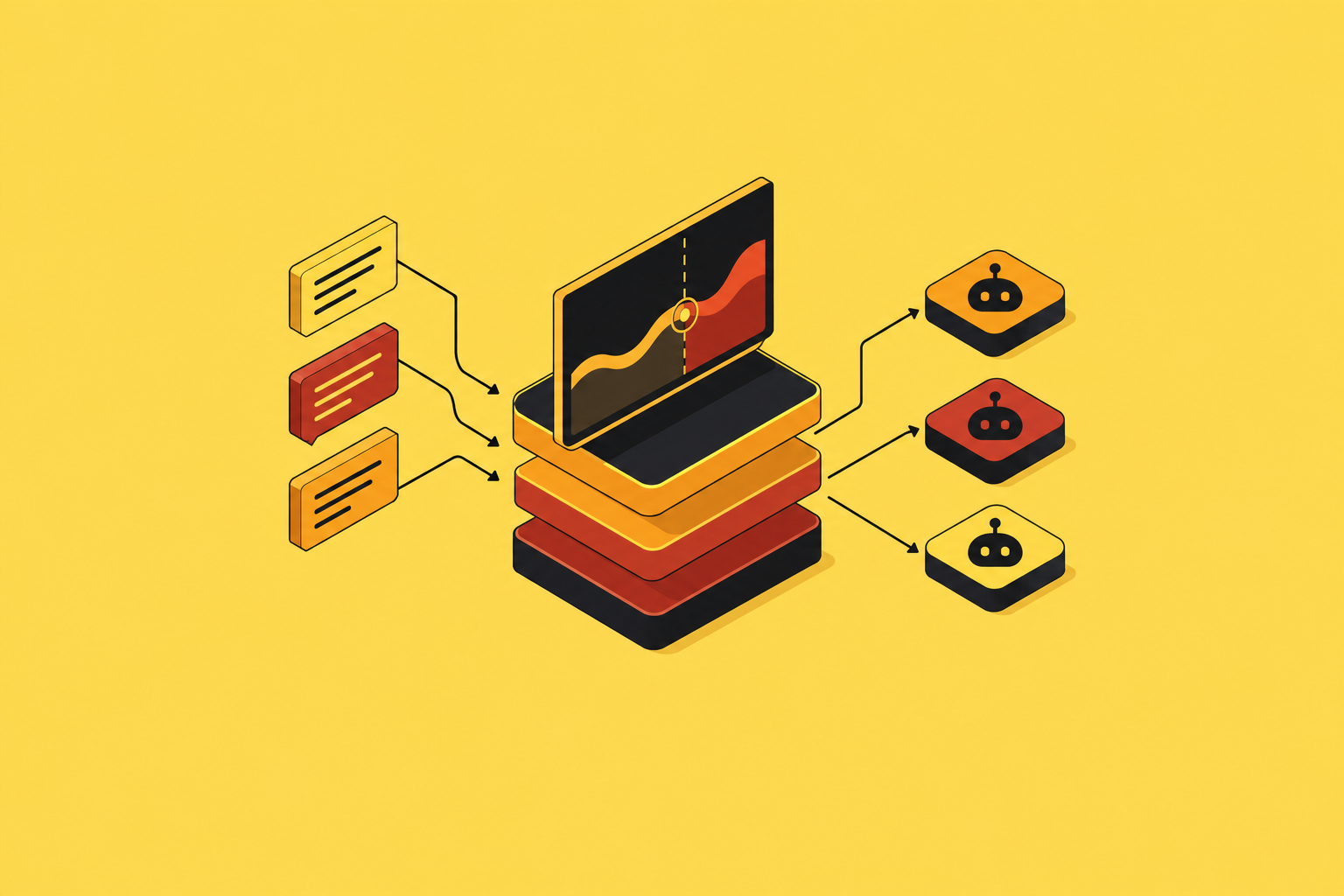
Silent failure detection for AI agents in production requires evaluating what an agent did against the instructions it was given, including when its execution succeeded. Semantic drift monitoring supplies that missing layer. It detects departures from intent in apparently successful runs and turns those failures into regression evals that test whether a fix holds.
Why semantic drift is a different kind of failure than the ones agents already report
A support agent resolves a ticket while violating the refund policy in its reply. The ticket is closed, the response is well formed, and nothing in the logs flags a failure. By the technical definition, the task succeeded. Yet the agent departed from the policy it was supposed to follow.
Semantic drift is progressive deviation from original task intent. Unlike a crash, timeout, or 500, it need not send execution into an error state. The output can remain syntactically valid and look like task completion while its meaning diverges from the intended behavior. No parameter change or system failure is required.
Elena Kopteva’s instrument paper identifies the same separation at the collective level. Individual agents can continue responding, completing tasks, and reporting healthy status while the semantic organization of their team changes. Ordinary system monitoring does not directly measure that process. Health signals therefore cannot establish fidelity to intent, even when every component appears operational.
The three-part drift taxonomy and why semantic drift surfaces first
Abhishek Rath’s framework distinguishes semantic drift, coordination drift, and behavioral drift. Semantic drift is deviation from original intent, coordination drift is a breakdown in multi-agent consensus, and behavioral drift is the emergence of unintended strategies. An agent can answer a different question from the one assigned, agents can lose agreement about their work, or a system can develop an unintended way of pursuing its task.
Rath’s simulation-based analysis and theoretical modeling show semantic drift happening first, with nearly half of agents affected by 600 interactions within that framework. It establishes the ordering within the framework, while behavioral drift progresses more slowly. Coordination failures concern a different relationship, namely whether agents’ consensus mechanisms remain effective as interactions accumulate. The taxonomy does not make every semantic failure evidence that all three forms are present.
Waiting for conspicuous changes in routing or tool use can leave earlier departures from intent unexamined. Rath’s proposed Agent Stability Index reflects the need for broader measurement by tracking 12 behavioral dimensions, including response consistency, tool usage patterns, reasoning pathway stability, and inter-agent agreement rates. A latency or error-rate signal cannot substitute for that range. Early detection creates an opportunity to intervene before deviations become harder to unwind.
How context compaction silently erases the constraints agents were given
As a long-running session accumulates turns, older content is compacted or dropped, including constraints supplied at the start. The original prompt need not change at all. What changes is the context available during execution, and therefore the force those instructions exert on later decisions.
Consider a multi-turn coding-agent session that begins with “always verify before claiming success” and “never fabricate prior agreements.” As the session grows, compaction can keep what comes up often in the work while losing these low-frequency constraints. A later completion claim may then omit verification, or an answer may invoke an agreement that never occurred. This is a hypothetical illustration of the failure mechanism. The important distinction is that a requirement can remain in the session’s history without governing its current behavior.
Nautilus Compass characterizes long-session coding-agent drift through forgotten user constraints, repeated mistakes the user already flagged, and confabulated prior agreements. It also distinguishes drift from retrieval failure. An agent may have the relevant memory but fail to act on it, so restoring access to text is not by itself proof of restored compliance. Monitoring must assess the instruction’s behavioral effect. A log showing that the constraint was supplied establishes what the agent should have done.
How do you know when your AI agent is giving wrong answers instead of crashing?
Latency, throughput, and error rates can show whether a workflow ran normally. Even an accuracy metric depends on what it evaluates. Unless it checks the agent’s actual constraints, it cannot show whether an otherwise correct answer followed a refund policy or communication rule.
Tracing does not resolve that distinction by itself. Commonly instrumented traces and spans record which tool ran and how long it took, but successful invocation is not evidence of a justified invocation. Nor does it show that the output followed the instructions. Many agent architectures have no mandatory evaluation point between deciding to act and completing the action. Reasoning, action, and reporting go ahead without a semantic check.
Rath’s Master Router Agent scenario illustrates why isolated execution records can look unremarkable. Small changes accumulate as routing increasingly favors certain agents, query wording shifts toward statistically common but contextually inappropriate forms, and handoffs develop redundancies. Each change can be difficult to perceive alone. Their cumulative effect is not explained by a failed tool call.
Splunk Agent Observability points to the need to track reasoning, tool calls, and output quality beyond what general-purpose monitoring shows. Those signals need evaluation built for that purpose and linked to execution data. The architectural answer to “but there is tracing” is to use traces as evidence for a semantic check that evaluates them.
What semantic failures look like in customer support, finance, and CRM agents
In customer support, the wrong action is a reply that departs from approved refund-policy language while resolving the ticket. The system records completion. Latency dashboards have no reason to react, and no error code identifies the departure. A customer escalation or supervisor spot-check may be the first effective review. The failure lies in what the response authorized or represented.
In finance, the wrong action is generating a report that applies a policy inconsistently. A prompt that produced an acceptable interpretation yesterday may produce a subtly different one today, particularly after a model update. The report can still be generated successfully. In a regulated setting, inconsistent interpretation makes the reasoning harder to audit and can leave compliance gaps undetected. Here, the required comparison is between the report’s treatment of the policy and the policy the agent was instructed to apply.
In CRM, the wrong action is sending a communication that promises a product feature inconsistent with the company’s current state. An agent with access to CRM data can still act in the wrong way. The email can reach its recipient successfully even though the agent’s behavioral context is out of step with the business. A mishandled message can then cascade through procurement, legal, and finance workflows.
What the missing monitoring layer must actually do
A semantic-drift monitoring layer must preserve enough execution evidence to audit what the agent decided and why. The support case requires more than the fact that a ticket closed. Evaluation needs the response and the applicable instructions so that it can compare the completed work with its constraints. The reference is the instruction set actually given to the agent.
That comparison must evaluate meaning. A response can get every fact right and still break the refund policy, communication protocol, or risk-labeling rulebook. Factual correctness is therefore necessary but insufficient for these workflows. Evaluation must distinguish a plausible answer from an authorized one. This also addresses compaction, because the check tests whether an original constraint still shapes behavior.
The layer must also group recurring failures into issues and derive evals from real failures. Grouping turns repeated policy violations into a diagnosable pattern instead of a stream of disconnected anomalous traces. Slack alerts place that signal in the team’s existing workflow. The resulting issue must support diagnosis, a proposed fix, and verification after the change.
Weight access is not a prerequisite for every drift signal. Compass operates at the prompt-text layer using cosine similarity between user prompts and behavioral anchor texts, aggregated by a weighted top-k mean with text-model embeddings. It reports ROC AUC 0.83 on a held-out test set built from real Claude Code session traces, without calling an LLM at index time.
Instrumenting the frameworks teams already run
Capture execution evidence before adding semantic evaluation. OpenAI Agents SDK provides built-in tracing enabled by default. A full-run trace covers the Runner.run() workflow, agent spans, generation spans, function/tool call spans, guardrail spans, and handoff spans. Those records make it possible to check decisions across a run.
LangGraph’s checkpointing API, stabilized in late 2025 with LangGraph 1.0, supports long-running agents that need to resume after restarts. The production pattern uses a BaseCheckpointSaver implementation, such as PostgresSaver or RedisSaver, to persist agent state, then wires the saved checkpoint into an OpenTelemetry trace as a span attribute. State persistence and tracing serve different purposes. Their connection makes saved execution context available for evaluation rather than leaving it separate from the run under review. LangSmith traces add node-by-node state diffs, full execution graphs, model and tool call breakdowns, and replay against new models or prompts.
The OTel GenAI semantic convention provides operation types including create_agent, invoke_agent, invoke_workflow, and execute_tool. MCP instrumentation enriches the existing execute_tool span. That distinction becomes relevant when the monitoring workflow hands failure context to a coding agent for a proposed fix. Mastra and Vercel AI SDK also support OTel-first tracing, allowing their runs to feed the same evaluation pipeline. Across these frameworks, the additional step remains explicit comparison of outputs and actions with the instructions governing them.
Turning production failures into evals and closing the loop through MCP
Production failures can help test later changes when they are saved as persistent regression evals. Real interactions bring together context and constraints in more ways than hand-written assertions can cover in practice at scale. Each interaction can become a candidate for quality scoring, regression detection, and prompt optimization. Not every trace is a failure. The evaluation process finds which examples should guide decisions on what to deploy and which failures need a test that stays in place.
A test for a refund-policy violation needs to stay in place after the fix. Changing a prompt can resolve the original violation while introducing another deviation. Re-running evals derived from production failures checks whether known constraints still hold after the change. The original case tests the original failure. Testing more than the original failure requires keeping other relevant cases, since one successful replay does not prove that the agent is now reliable.
MCP connects the monitoring layer with the engineer’s coding environment. A failure trace, diagnosis, and suggested fix can be surfaced directly to the coding agent, avoiding a separate transfer of context from an observability console. Compass demonstrates a version of this connection at the agent-memory level. Its cryptographically chained audit log provides tamper-evident anchor updates, and its MCP 2024-11-05 A2A server supports clients including Cursor, Cline, Hermes, and OpenClaw. This makes the drift signal available where a correction can be applied.
The complete workflow detects a semantic failure, groups recurrences, diagnoses the departure against instructions, and proposes a fix through MCP. After the fix ships, failure-derived evals test it and alert on regression. This loop is designed to catch failures sooner than a support ticket that arrives nine days after an agent started giving replies that broke policy. The decisive signal is no longer that a customer complained, but that a completed response failed its governing instruction.
Sources
- 9 Best LLM Drift Monitoring Platforms in 2026
- Nautilus Compass: Black-box Persona Drift Detection for Production LLM Agents
- Measuring Collective Semantic Change in Populations of Language Model Agents
- Quantifying Behavioral Degradation in Multi-Agent LLM ...
- Agent Drift: Quantifying Behavioral Degradation inMulti-Agent LLM Systems Over Extended Interactions