Grounding Checks Against Tool Outputs in Agentic Pipelines
Validate tool outputs before the model reads them, not after.
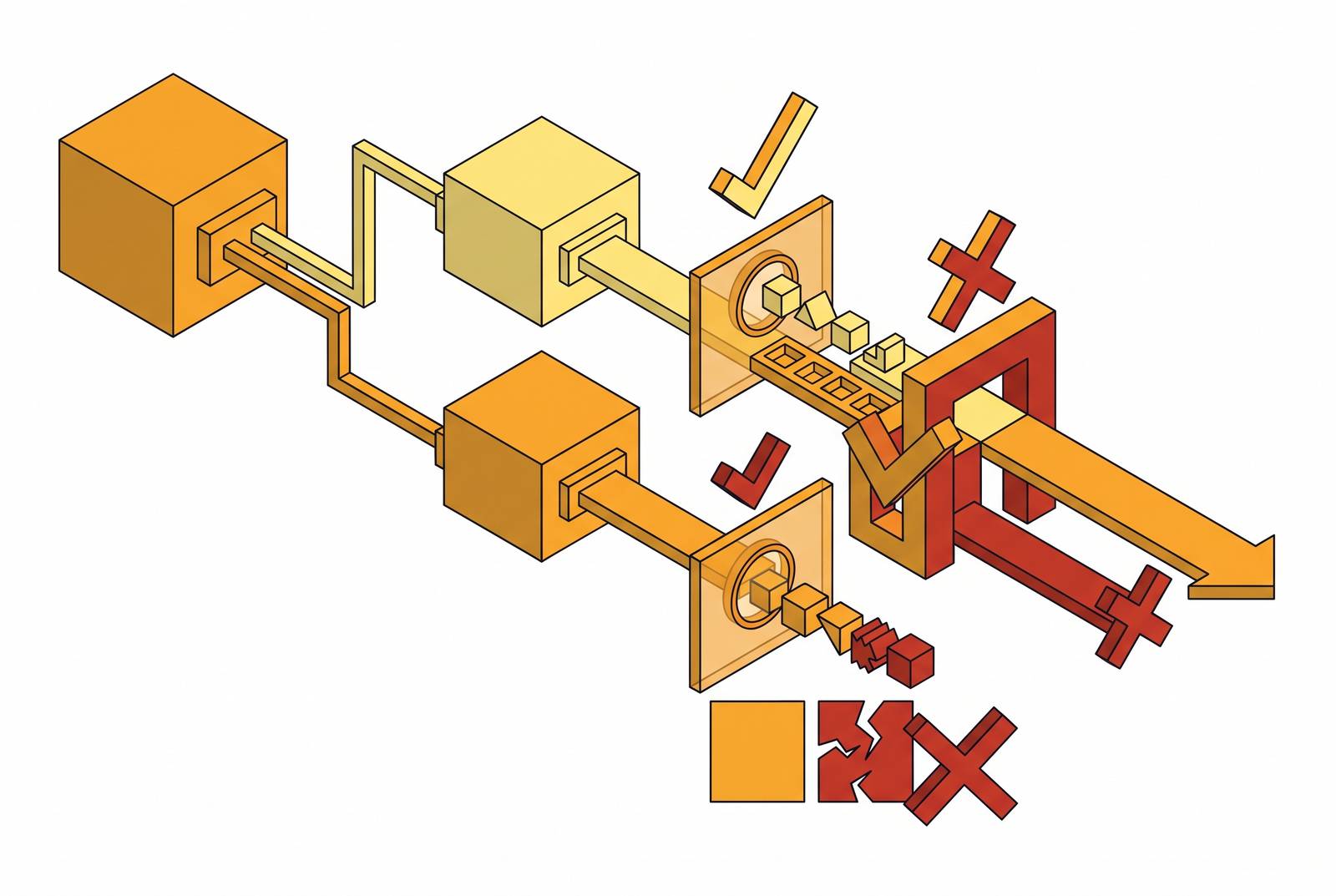
Traditional error monitoring fails for AI agents because a tool request that succeeds does not prove that its output is valid evidence. Validating tool responses before the model uses them closes that gap. Final-response checks come too late to stop corrupted context from driving the next tool call.
Why tool outputs are where agent grounding actually breaks
An HTTP 200 shows transport success but does not show whether the evidence returned meets the task’s requirements. A call that matched nothing, returned stale data, or encountered a schema change can look identical to a successful call at this layer. The model receives a parsable body with no actionable error signal. It can then improvise around the broken response and continue as though the evidence were sound.
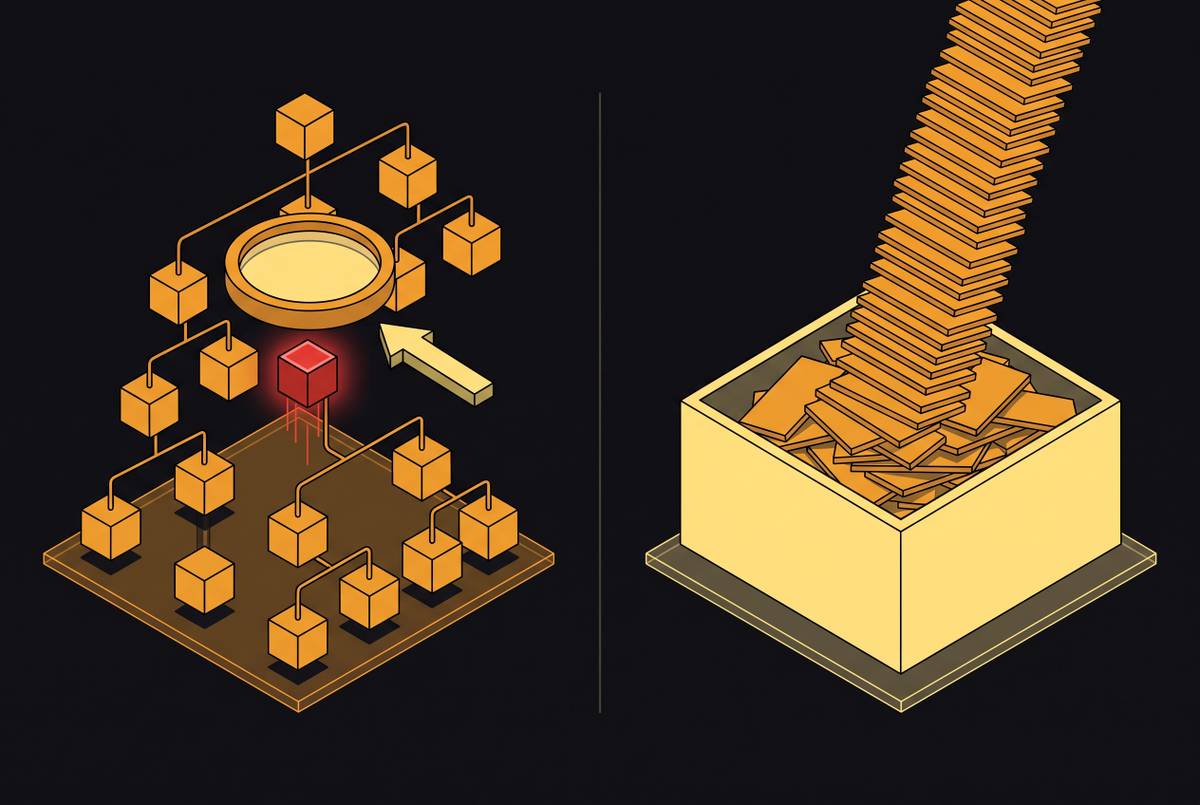
That interface creates a grounding breakpoint between the tool’s response and the model’s next step. In a multi-step pipeline, an unsupported assumption introduced there can become an argument to another tool. The later call may work as it should while using the wrong evidence. When only the final response is checked, those earlier decisions fall outside the guardrail.
SilentProbe found that detection rates for silent tool failures did not vary by model family, scale, or price. A more capable model is not a substitute for an explicit contract governing what a tool response means and whether the agent may use it.
Why does an agent look fine in logs but still give bad outputs?
The fintech field-rename case gives this failure a concrete shape. A tool response changed from account_id to accountId, yet the failure survived contract testing and HTTP monitoring. The model saw a plausible response and continued. The trace showed a tool span that returned degraded data, followed at once by a model span that used that data as valid evidence. A strict output validator would have caught the mismatch before the response entered the model’s context.
ToolUniverse found that missing data or fields and inconsistencies in search and filtering results were among the most common failure types. These failures originated in the API or wrapper layer and propagated into apparently valid scientific outputs. A related signature is an identifier supplied from the model’s parametric memory. The identifier looks plausible, but downstream calls that reference it inherit the error.
Transport-level monitoring cannot establish that relationship between evidence and reasoning. Even repeated calls may look like normal traffic instead of an agent loop unless their context is checked. Lemma audits agent traces against instructions and can surface the point where a tool response deviates from what was promised. Span-level auditing makes the boundary visible rather than asking engineers to infer it from the final answer.
Why the failure categories that matter most are silent ones
Tool errors and retrieval errors are the direct targets of tool-output grounding checks. Tool errors to check for include wrong arguments, a failed response that goes unhandled, and retries that keep the same broken shape. Retrieval errors include the wrong chunk, a hallucinated source, and context that becomes stale before the model acts. None necessarily produces an exception. Their defining problem is that execution can continue without evidence remaining valid.
SilentProbe found that models asserted a false negative to the user in 41% of silent-failure runs. The runs produced no exception, crash, or alert in traditional monitoring. A longitudinal production study of a personal-assistant agent runtime documented a recurring pattern in which failure signals never reached a human in actionable form.
Microsoft’s updated taxonomy also identifies session context contamination and MCP/plugin abuse as failure modes. Both can corrupt the context that later tool calls rely on. For grounding checks, the system must intercept corrupted context before another span depends on it.
What a grounding check is and what it must verify at each tool span
A grounding check requires every entity in the final answer to appear in a prior tool output. Applied after generation, it verifies the completed answer against its evidence. Applied inline, it gates what the model can carry into the next span before another tool call executes. This turns grounding from an assessment of the final text into a constraint on execution.
AgentLTL, derived from First-Order Linear Temporal Logic, expresses that requirement as a trace constraint. Every entity in the model’s forward context must appear in prior tool outputs. Its block-and-warn harness improved compliance on five of seven models tested. The practical decision is to compare an entity against recorded evidence before allowing it to influence downstream work. That comparison catches a plausible identifier whose only source is the model’s memory.
Each tool span must therefore record the tool name, arguments, raw output, duration, retry count, and explicit error state. A summary or truncated result gives less to go on when checking whether an entity was actually returned. OpenTelemetry’s gen_ai.execute_tool span has tool-name and error-status fields, with optional arguments and results where privacy policies allow them. Duration is tracked as a separate metric. These fields provide an instrumentation layer for checks, but optional output capture must be addressed if the check requires raw evidence.
Schema enforcement as the first grounding check an engineer should add
The first check belongs right after the raw tool response and before model context assembly. Define a strict output schema for each tool, separate from its input schema. Validate the response against that schema before passing it forward. This requires no ML component and makes the output contract executable. In the fintech case, the field rename would fail at this boundary.
The schema should catch renamed fields, missing required properties, and types that would otherwise be coerced into plausible but incorrect values. It should also distinguish an allowed empty result from an invalid empty payload that could be interpreted as no results when the query actually failed. On validation failure, short-circuit the run and return a structured error. Record the validation result in the tool span so the failure is explicit.
Output schemas also need versioning and checks against deployed API versions in CI. Otherwise, an integration that passed initially can fail after an API changes. Structural validation still has a firm limit, however, because a correctly shaped value can be wrong for the task. SilentProbe found that 40.1% of production OpenAPI documents state at least one constraint in prose that their schema does not encode. Those rules require a separate check.
Constraint checks for what schema validation cannot see
Semantic checks ask whether a response with a valid structure is right for this agent, task, and moment. Referential integrity tests whether a returned identifier belongs to the set the agent is authorized to act on in the session. Temporal validity tests whether the data is fresh enough for the intended action. These are familiar engineering constraints.
Policy compliance and completeness extend the same principle. A refund amount may have the right type but exceed the ceiling in the agent’s instructions. A response may have valid records but give only a partial result that the server did not flag as partial. Neither problem can be resolved by checking field names alone. The check must compare the response with the rule that governs its use.
The agent’s own instructions are a useful source for those rules. Instruction-based trace auditing, including the approach used by Lemma, checks behavior against what the agent was told to do rather than relying only on a predefined catalog of failures. Apply these constraints after raw output capture and before context assembly. A payload that fails should be withheld, with a structured error taking its place through the error-handling path. Evidence membership and permission to act on that evidence are separate requirements, and both matter.
Propagation control that stops a failed check from feeding the next tool call
An inline check that records a failure but lets the run continue unchanged provides detection. Even a structured error can become material for improvisation if it is simply handed to the model without a defined control path.
First, define an explicit error-handling path for each tool that returns a structured error object to the orchestrator. Next, make the orchestrator choose whether to retry with different arguments, escalate to a human, or terminate the run. Finally, bound retries and record their count. Repeating the same failed call with the same arguments adds a planning error without repairing the tool failure.
The trace should show an explicit failure state followed by termination or a new tool span with different arguments. This is also the containment boundary for session context contamination. Data let in early in a session can skew later decisions even when later tools work as they should. Preventing that admission is more effective than asking a final-response check to reconstruct every downstream consequence.
What to instrument and alert on so grounding failures surface before users see them
The span record must expose not just the tool’s behavior but the check’s outcome. Record pass or fail and the failed constraint as span attributes. Also record whether execution continued after failure and which policy allowed it. These additions connect the evidence captured at the tool boundary to the control decision that followed. Without that link, an engineer can see that a check failed but cannot tell whether it kept the run safe.
Start alerting on cost per run, steps per run, and task success rate. A jump in cost or steps can signal a loop or a prompt change that degraded tool-call quality. A drop in task success exposes correctness regressions that HTTP status codes miss. Add tool-call success rate because a run can finish with a passing status even when it has failed tool spans.
Group failures by constraint type. Referential integrity failures in many runs suggest that the runs share a tool or data source behind the failures. Span-level auditing must make those patterns actionable while grounding breakpoints can still be contained. The longitudinal production study found that failure signals repeatedly failed to reach humans in actionable form across weeks. Its lesson is that check logic alone is insufficient when instrumentation does not carry the result to someone who can act.
Turning grounding checks into regression tests that run before each deploy
Most benchmarks score a final answer or a fixed list of expected tools. Neither establishes whether the answer was grounded in the outputs produced during execution. A final string that looks right can hide unsupported reasoning, just as a request that succeeds can hide degraded data. The execution trace supplies the evidence needed to score that distinction. Trace-based evaluation can reward correct use of tool outputs and penalize unsupported entities.
The same constraint can serve both runtime enforcement and pre-deploy evaluation. AgentLTL’s dual usage makes this explicit by applying a grounding specification inline or using it to score completed traces. Capture the tool and model spans of a known-correct run as a baseline. For each candidate deploy, replay the same inputs and compare the grounding results for each span. A new failure on a previously passing span should block deployment or trigger review.
Clusters of new failures under the same constraint can point to a schema or prompt change. Versioned output schemas and trace replay bring that risk into CI. Through Slack and coding agent integrations, Lemma surfaces deviations against agent instructions within the development workflow. The governing principle remains the same from runtime checks to regression gates, which is that evidence must pass its checks before the agent is allowed to build on it.