Sentry Requires a Throw Statement to Open a Case and Agent Misjudgment Never Throws
Agents succeed at wrong tasks without throwing errors.
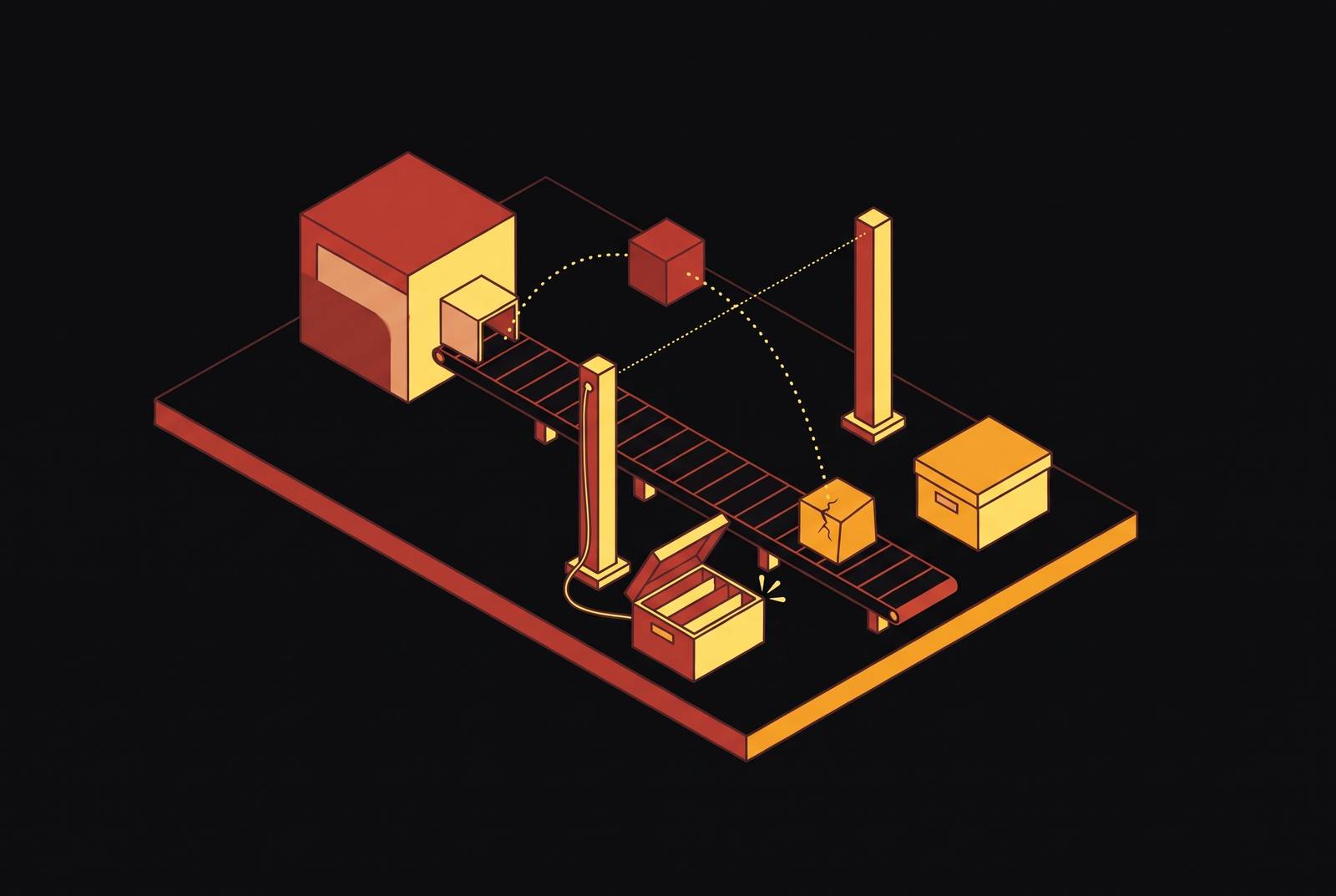
Traditional error monitoring fails for AI agents when it treats successful execution as evidence of a correct outcome. Sentry’s exception-based detection can catch a failed operation, but an agent can choose the wrong operation, execute it successfully, and return a plausible answer. Detecting that misjudgment requires comparing the agent’s decisions and output with its instructions.
Why Sentry's architecture assumes failures throw
Exception-based monitoring begins with a failure signal that the runtime exposes. An uncaught exception, a non-2xx status code, or a timeout gives monitoring infrastructure something concrete to capture and investigate. In the exception path, an error is thrown, the SDK intercepts it, a case opens, and an alert brings the failure to a developer’s attention. The stack trace supplies the execution context.
This is a reasonable design for execution failures. A null pointer dereference throws, a network operation fails or returns an error status, and a bad database query raises an exception or returns an error result. Each exposes a mechanical failure rather than requiring the monitor to judge the purpose of the operation. That distinction explains both the usefulness and the boundary of exception monitoring. It can report that an operation failed, but successful execution does not establish that the software performed the right operation.
What agent misjudgment actually looks like at the execution layer
Agent misjudgment is a valid execution that produces a wrong outcome relative to the task. The runtime performs the operation it receives, the response code is 200, and latency remains normal. Yet the answer is wrong for the user. The defect lies in the decision that selected the operation or interpreted its result. A monitor looking only for broken execution therefore receives evidence consistent with success.
An agent routed tickets to the wrong queue for nine days while p95 latency remained at 1.9s, the error rate stayed at 0.0%, and uptime remained green. A human eventually noticed misrouted tickets in a refunds queue. The infrastructure measurements described operational health. Nothing in those measurements distinguished a promptly completed wrong decision from a promptly completed correct one.
Its postmortems describe failures that escaped the signals being watched, including a dead mesh whose health checks remained green. Some failures left records where nobody was looking. Semantic misjudgment presents the harder version of the problem, because the operation itself can succeed and leave no execution error to discover.
Openlayer describes how tool calls can produce this ambiguity. An agent can pass arguments with the wrong type or key name, and a tool can silently misinterpret them or return an empty HTTP 200 payload. The agent then proceeds on a null response as though the call succeeded. Repeating the same failed call without backoff or loop detection can also run up costs while producing output that looks right. These cases need not generate the exception that would start an error investigation.
Priyanka Bajaj’s Evaluation Blindness: How Silent Measurement Failures Corrupt AI Systems from Training to Deployment defines evaluation blindness as a measurement function’s value being indistinguishable from a non-failing state while the system is failing, with no auxiliary signal flagging the discrepancy. The measurements need not be inaccurate. Error rate can correctly show that there were no execution errors while saying nothing about whether tickets reached the right queue.
Why an agent looks fine in logs but still gives bad outputs
The call stack records execution mechanics. It can expose where an operation raised an exception or which calls led to that point. Establishing whether the selected tool was appropriate for the user’s request requires a different frame of reference. The relevant comparison is between the agent’s instructions and its decisions.
Openlayer identifies non-determinism as a reliability challenge because the same prompt can lead to different tool selections, arguments, and outputs without a code change. So a test run that succeeds does not tell what a later run will choose. The runtime executes whichever valid call the agent supplies. Unless some other mechanism evaluates that choice against the task, incorrect selection remains outside the execution monitor’s view.
The paper describes a multi-agent system that ran reliably for weeks without code changes, then failed to pass critical context between agents on day 47. No error message, timeout, or resource bottleneck announced the failure. The task completed with subtly degraded output. What was passed diverged from what should have been passed, while execution continued.
More detailed stack traces may help reconstruct the operations, while resolving that discrepancy requires judging whether those operations preserved the context needed to satisfy the task. Even a swallowed exception leaves an underlying execution failure whose cause has been obscured. Semantic misjudgment need not create such a failure at all. This is why an agent can look healthy in logs without the monitor being misconfigured or the logs being false.
How the mismatch compounds across multi-step agent workflows
In a multi-step workflow, a wrong decision becomes input to later decisions. Openlayer describes a propagation chain in which the first step retrieves wrong context, the second produces a malformed result, and the third reasons over bad data without recognizing it as bad. Each operation may still complete successfully. By the time the final response arrives, the first mistake is several steps behind the output. Looking only at the last step risks mistaking an effect of the error for its cause.
Successful downstream execution can therefore make the workflow look healthier than it is. Each completed call shows that another operation ran, even though its input may already be corrupted. This is not a contradiction in the telemetry. The contradiction arises when operational success is interpreted as evidence of task success. Across a long workflow, that interpretation allows an early semantic error to accumulate a trail of apparently reassuring execution events.
Neogen’s six-day dead mesh shows how persistent this gap can become. Every health check remained green because the checks measured presence without checking whether useful work was happening. Its postmortem states, “Every health check in the stack was green, because nothing in the stack was counting”. The workers’ failures were recorded where nobody was looking. Unlike a purely semantic failure, this case had failure records, but the watched signals still failed to establish whether the workflow was accomplishing its purpose.
In the cascade described in the notes, Agent A hallucinates a customer ID, Agent B accepts it as valid input, and Agent C modifies the wrong customer’s account. Agent C’s audit logs do not expose where the customer ID became wrong. Its local operation can be consistent with the input it received while violating the original task. Attribution requires following that input across the handoffs.
The Entropy Principle paper describes accumulated semantic deviations as monotonically increasing disorder as interaction rounds grow under the conditions it identifies. Output consistency, task accuracy, and cross-session coherence degrade without a single execution failure explaining the decline. A workflow can lose fidelity to its task gradually, while its components continue to satisfy their local execution contracts.
What monitoring infrastructure would need to see in order to catch semantic misjudgment
Detection requires an observable relationship between intended behavior and actual behavior. Status codes show whether requests completed under a protocol, while schemas show whether outputs have the expected form. Neither establishes that the agent followed its instructions. The monitor needs evidence about the task itself. Without that reference, a valid but incorrect decision remains indistinguishable from a valid and correct one.
Full decision traces provide the first part of that evidence. They must capture which tools were called, the arguments passed, the results returned, and how those results shaped the next step. Ordinary execution logs may omit those relationships entirely unless they are explicitly instrumented. Capturing events alone is not enough. A useful trace preserves the path from an input through a decision to its consequence, so that an investigation can reconstruct what the agent did.
Output validation must then compare the result with intent as well as checking schema compliance. A well-formed routing decision can still send a ticket to the wrong queue. Behavioral baselines also show when routing patterns change, even when no operation throws. Cross-step context tracking serves a different purpose. It allows corruption introduced at step two to be attributed there, rather than appearing only as a bad result at step five.
These requirements follow directly from evaluation blindness. A measurement cannot detect a failure class if failing and non-failing states produce indistinguishable values and no other signal separates them. The measurement must therefore become sensitive to semantic correctness. Instrumentation is a prerequisite, but badly structured spans can still leave dashboards silent about reasoning quality. The essential change is not simply collecting more events, but preserving and evaluating the relationship between the task, the decisions, and the outcome.
Why intent-aware trace auditing is the structural answer to a structural problem
Intent-aware trace auditing compares a trace with the agent’s own instructions to check whether the recorded decisions did what the task called for. The trigger is a deviation from intent. It need not wait for a tool call to fail, a status code to change, or a timeout to expire. That makes it suited to plausible but wrong behavior that remains valid at the execution layer.
Auditing every trace also creates a basis for grouping deviations into recurring patterns. This differs from requiring a team to anticipate and encode every possible failure mode before deployment. Neogen’s postmortems indicate that most of its failures belonged to modes nobody had anticipated. A fixed set of predefined alarms cannot catch a mistake nobody planned for just because the operations are instrumented. Pattern grouping lets developers look into the deviations they find together, without treating each trace as a separate incident.
Detection must also connect to the workflow in which corrections happen. Slack alerts and integration with coding agents can surface the failed trace without requiring a separate monitoring console to become the starting point for every investigation. Framework-compatible instrumentation avoids making replacement of existing tooling a prerequisite. Exception monitoring retains its role in diagnosing mechanical failures. Intent-aware auditing adds a check of whether the operations that ran successfully did the requested work.
When a production trace fails evaluation, it becomes a regression case in the next test cycle, and the same scorer can test for that pattern before another release. The production finding supplies a concrete failure to guard against. This closes a semantic feedback loop that exception capture alone cannot provide, because no thrown error was needed to identify the defect in the first place.